
Bitcoin is more than a cryptocurrency in Nigeria—it’s a financial lifeline. From dodging naira inflation to sending remittances and preserving wealth, Nigerians have embraced Bitco...
Published:
Source: Original X article/post

Bitcoin is more than a cryptocurrency in Nigeria—it’s a financial lifeline. From dodging naira inflation to sending remittances and preserving wealth, Nigerians have embraced Bitcoin like few others, ranking among the world’s top P2P traders. But our journey with BTC hasn’t been smooth.
The Story: MMM and Bitcoin in Nigeria
In 2015-2016, Mavrodi Mondial Moneybox (MMM), a notorious Russian Ponzi scheme, swept through Nigeria promising 30% monthly returns. It lured millions—estimates suggest around 3 million Nigerians participated—during a time of economic hardship following a recession triggered by falling oil prices. MMM initially operated with fiat currency, but as Nigerian authorities cracked down on its bank accounts in late 2016, the scheme pivoted to Bitcoin, encouraging participants to use it for payments. This was a turning point: for many Nigerians, MMM was their first exposure to Bitcoin, framing it as a tool for quick riches rather than a decentralized currency.
For many, Bitcoin’s introduction came through a dark chapter: the 2017 MMM Ponzi scheme collapse. Since then, we’ve battled high fees, slow transactions, and usability issues—forcing many to explore alternatives like stablecoins on Ethereum.

Yet, Bitcoin’s fundamental strengths remain unmatched: security, decentralization, and trust. Now, with ZK Rollups, Bitcoin has a chance to scale, process transactions instantly, and even become the most powerful platform for stablecoins—reshaping Nigeria’s financial landscape.
Bitcoin’s Growing Pains: High Fees & Slow Transactions
Just as Bitcoin gained traction, its limits became clear;
- Bitcoin’s blockchain was never built for speed. It processes ~7 transactions per second (tx/sec) with 10-minute blocks.
- In 2017, as Bitcoin’s price hit $20,000, fees skyrocketed—reaching $20, sometimes $50+ per transaction.
- Sending ₦10,000 in BTC to a friend could cost ₦5,000 in fees and take hours if you didn’t overpay to jump the queue.
For us, this was a serious barrier. Bitcoin was becoming “digital gold” for hodlers, not an everyday currency. Even in 2020, during the EndSARS protests, BTC helped fund activists when banks failed. But fees still stung and donors groaned, limiting its usability.
How Ethereum Scaled and Unlocked Its Economy
Ethereum didn’t just solve scaling—it transformed into a global economic engine, and stablecoins, NFTs, DeFi, and other innovations were the keys. When Ethereum launched in 2015, it faced Bitcoin-like challenges: slow transactions and high costs. But its smart contract platform opened the door to possibilities Bitcoin couldn’t touch. By 2020, Ethereum’s ecosystem exploded, fueled by:
- Stablecoins: USDT and USDC turned Ethereum into a dollar-based economy. With $170 billion in stablecoin supply by 2024, users could trade, save, and pay without crypto’s volatility—settling $5.28 trillion annually. Nigerians flocked to this, escaping naira swings.
- DeFi (Decentralized Finance): Platforms like Uniswap and Aave let users swap tokens, lend, and borrow without banks. DeFi’s total value locked hit $100 billion by 2025, offering Nigerians alternatives to a shaky financial system.
- NFTs (Non-Fungible Tokens): From digital art to land titles, NFTs gave creators and businesses a way to tokenize assets. Nigerian artists have sold millions in NFTs, proving Ethereum could empower local talent.
- Layer-2 Scaling: Rollups like Optimism and Arbitrum slashed fees from $50 to cents and boosted capacity to thousands of transactions per second. This made Ethereum usable for everyday needs, not just speculation.
Ethereum’s economy unlocked because it paired scalability with utility. Stablecoins brought stability, DeFi offered financial tools, and NFTs created new markets—all on a secure blockchain. By 2025, Ethereum’s flexibility made it the go-to for stablecoin volume and beyond.
Bitcoin, with its $1 trillion security, can follow this playbook. ZK Rollups are the missing piece to replicate—and surpass—Ethereum’s success.
Nigerians’ Stablecoin Hunger: Saving in Dollars
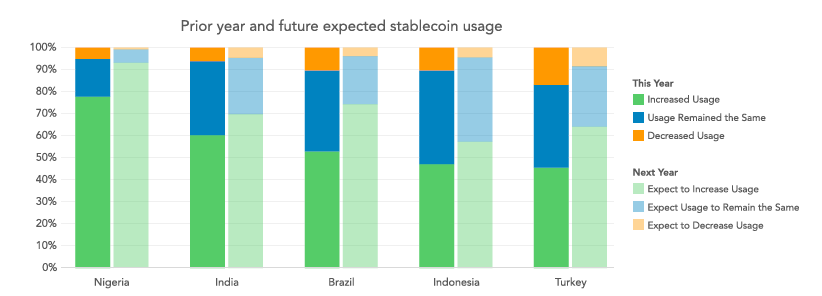
As Bitcoin struggled with usability, another trend took over: Stablecoins. A 2024 survey by Visa, BHDigitalAssets, and Artemis found that Nigerians have the highest global demand for stablecoins—driven by a need to save in dollars amid naira instability.
According to Nic Carter’s 2024 whitepaper:
- Nigerian users have the highest stablecoin affinity among the countries surveyed – by far. Nigerian users transact most frequently, stablecoins compose the largest share of respondent portfolios, they report the highest share of non-crypto-trading uses for stablecoins, and they maintain the highest self-reported knowledge of stablecoins
- For Nigerians saving money in dollars was the top objective, followed by trading crypto and obtaining better currency conversion rates.
- 77% of Nigerians have converted the Naira to Stablecoins at least once.
Why? Because stablecoins let Nigerians hold USD without needing a bank. The naira’s volatility made this a necessity, not a luxury.
Ethereum’s Lead: Stablecoins on Secure Smart Contracts
While Bitcoin lagged, Ethereum took the lead.
Ethereum’s smart contract infrastructure made it the dominant platform for stablecoins like USDT and USDC. Ethereum layer-2 rollups (Optimism, Arbitrum) slashed fees, boosting stablecoin adoption.
By 2025, Ethereum handles most stablecoin volume, offering:
✔️ Faster transactions
✔️ Lower fees (on L2s)
✔️ Smart contract flexibility
https://x.com/nic__carter/status/1834227219041837539
But Ethereum has its flaws—gas fees still spike to $50+ during congestion, and its complexity turns off casual users. This leaves an open door for Bitcoin.
The Case for ZK Rollups: Bitcoin’s Stablecoin Future

Bitcoin’s stablecoin potential is untapped—but ZK Rollups can change that.
Here’s how ZK Rollups work:
- Off-Chain Efficiency: Transactions happen off-chain, reducing congestion.
- Zero-Knowledge Proofs: A cryptographic “receipt” proves transactions are valid without bloating Bitcoin’s blockchain.
- Bitcoin’s Security: The rollup settles as one small transaction on BTC’s chain, preserving Bitcoin’s decentralization.
The Results?
✅ Transaction fees drop to pennies
✅ Transaction speed jumps to seconds
✅ Capacity expands to 1,000+ tx/sec
No forks. No new coins. Just Bitcoin, upgraded. Ethereum’s rollups have already proven this works. But Bitcoin has something Ethereum doesn’t: A $1 trillion fortress of security.
Why Nigeria Needs Bitcoin-Powered Stablecoins
For Nigerians, stablecoins on Bitcoin would be a game-changer.
• Imagine holding USDT or USDC on Bitcoin.
• Sending it to your mom in Enugu for a 10 kobo fee in 2 seconds.
• Paying vendors instantly without high gas fees.
ALL ON BITCOIN
The data proves Nigerians want stablecoins. Bitcoin’s unmatched security + ZK Rollups can make this happen. With stablecoin adoption exploding and total settlements surpassing $5.28 trillion in 2024, Bitcoin has the chance to become the ultimate stablecoin platform.
Citrea: Bringing ZK Rollups to Bitcoin
This is where Citrea @citrea_xyz steps in.
Citrea’s BTC ZK Rollup isn’t a competitor to Bitcoin—it’s an upgrade.
✅ Near-zero fees
✅ Lightning-fast transactions
✅ Bitcoin’s security, Ethereum’s flexibility
✅ Open-source, developer-friendly
With Citrea, Bitcoin merges the best of Ethereum’s scaling with its own unmatched security. This is Bitcoin fulfilling its destiny.
For Nigeria, this is a reset: BTC as Satoshi meant it—not the sluggish beast of 2017.
Bitcoin onboarded us through MMM’s mess.
Bitcoin stumbled with fees and speed.
Now, Bitcoin is ready for its next chapter—with ZK Rollups.
Nigeria is leading this movement. Whether you’re a business, a developer, or a trader—this is your moment.
✔️ Are you building on Bitcoin?
✔️ Does your business have a Bitcoin Business model?
✔️ Are you ready to build Nigeria’s future with Citrea?
Join Citrea Nigeria. We’re scaling BTC for you, with you.
~ Nzube Ndiokwelu (Beaconsmith Collective)
Citrea Nigeria Ambassador

